
The price is in a spreadsheet, the photos are in a shared folder, and the dimensions are buried in an old message. A writer can turn those fragments into polished copy, but that does not make the underlying information reliable.
A product information template gives everyone one starting point. It records what is known, where each fact came from, and who needs to resolve the gaps. This practical version is designed for small shops and content teams preparing product descriptions and listings. It is an input document, not another round of proofreading.
1. Separate facts from writing ideas
A useful product brief does not have to sound persuasive. It needs to distinguish verified specifications from suggested angles and unanswered questions.
- Facts: material, dimensions, capacity, and what is included.
- Writing ideas: a possible setting or benefit supported by those facts.
- Unknowns: care instructions, compatibility, or performance claims that still need evidence.
“A quiet accent for a desk” is a creative direction. “Keeps drinks hot for four hours” is a measurable claim requiring evidence. Keep those categories separate so an appealing phrase does not accidentally become a product promise.
Also distinguish “not included” from “not confirmed.” A blank accessory field tells the writer nothing. A clear statement that the product comes without a lid answers a customer’s question.
2. Make every important fact traceable
For each specification, record its value, source, verification date, owner, and status. A source might be a supplier document, a label photograph, or a measurement record. Link to the actual file rather than writing “supplier confirmed.”
| Field | What to record |
|---|---|
| Value | A specific figure or description, with units |
| Source | A retrievable file, document reference, or link |
| Verified on | The date it was last checked |
| Owner | The person responsible for confirming or updating it |
| Status | Verified, awaiting confirmation, or not applicable |
Record measurement methods where they change the meaning. Capacity filled to the rim is not the same as a recommended serving volume. If two sources disagree, retain both and ask the owner to resolve the difference rather than choosing the more plausible number.
3. A blank template to copy
Use one record per item being handed over. Repeat the source and verification fields for individual specifications. Keep changing commercial information connected to its live source rather than maintaining a second price list inside the brief.
A. Identification
Internal reference: …
Product name for handover: …
Responsible person: …
Last updated: …B. Product facts
Material: …
Colour and finish: …
Dimensions and measurement method: …
Capacity or weight and measurement method: …
Unit of sale: …
Items included: …
Use and care instructions: …
For each fact: source · verification date · owner · status: …C. Commercial information
Current price source: …
Availability source: …
Applicable policies and links: …D. Images
Image ID · filename · subject · usage rights · fact illustrated: …
Main product image: …
Detail images: …
Lifestyle images and props not included: …E. Unresolved information
Missing fact: …
Person to ask: …
Response needed by: …
Decision: blocks listing / omit claim / add later
Statements not yet approved for use: …
4. Worked example: a ceramic mug
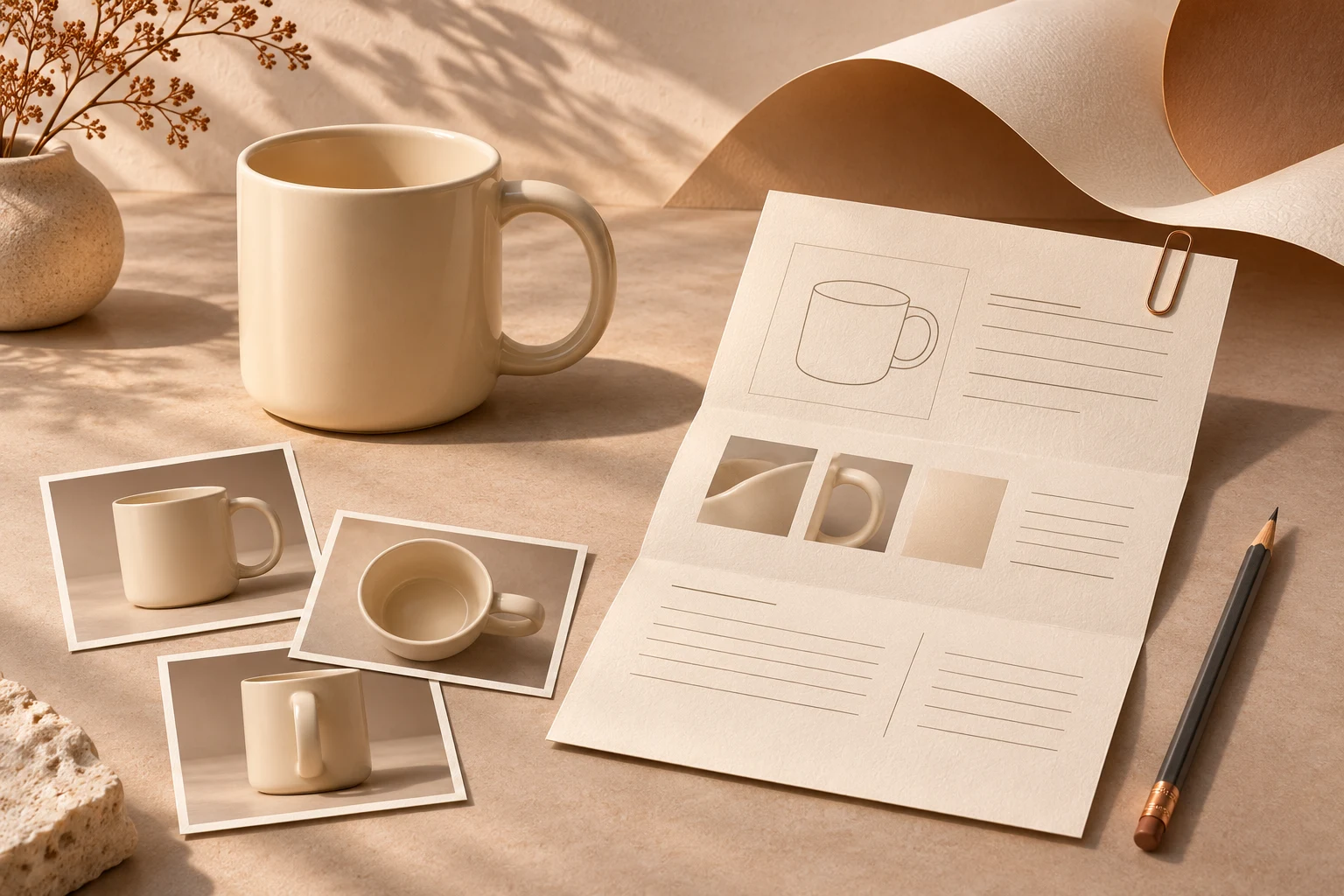
This is a fictional training example, not a product offer. The figures and document references below illustrate how to complete a brief. The article’s hero image is AI-generated editorial artwork, not evidence of real merchandise. Replace them with genuine records before using the template for merchandise.
For this fictional record, the evidence-backed rows carry a verification date of 4 November 2026 and the fictional owner “Lan, product lead.” Unconfirmed rows remain pending.
| Field | Example value | Example evidence or status |
|---|---|---|
| Material and finish | Ceramic; warm ivory satin glaze | Sample sheet A, verified within this fictional scenario |
| Capacity | 300 ml filled to the rim | Measurement sheet A; not a recommended fill level |
| Dimensions | 8.5 cm tall; 8 cm rim diameter; 11 cm wide including handle | Measurement sheet A, with measurement points recorded |
| Contents | One mug; no lid or saucer | Packing sheet A |
| Dishwasher and microwave use | Unconfirmed | Product owner to verify; omit these claims |
| Price and availability | Not entered | Retrieve from the selling system before offering for sale |
In a real record, add the verification date and owner to each row. The verified inputs could support this short description: “An ivory ceramic mug with a satin glaze and rounded handle. It measures 8.5 cm tall and holds 300 ml when filled to the rim. Each unit contains one mug, without a lid or saucer.” No claim about safety, heat retention, or appliance compatibility has been invented.
5. Map images to the information they show
For the example mug, image A01 could show the whole item, A02 the glaze and handle, and A03 the mug on a desk. Identify any book or cloth as a styling prop. A photograph can show shape and appearance; it does not establish capacity or heat resistance.
For Merchant Center submissions, Google requires the main image to show the actual item and excludes promotional overlays. Keep that asset separate from banners with prices or calls to action. See Google’s main product image guidance.
Add a proposed alt description, then check it against the selected image: “Ivory ceramic mug with a rounded handle, viewed from the side.” Editorial AI illustrations should remain clearly distinct from photographs offered as evidence of actual merchandise.
6. Give missing information a decision
A missing lifestyle photograph may be added later. An unclear unit of sale should be resolved before selling. Omit unsupported claims; if the missing fact is essential to appropriate use, have the product owner verify it first.
Price needs its own current source. For Merchant Center, submitted pricing must match the landing page and checkout under Google’s price guidance. This is a data consistency requirement, not a promise of better search rankings.
A short handover checklist
- Important specifications have retrievable sources.
- Units, measurement methods, dates, and owners are clear.
- Included items are separate from styling props.
- Images are mapped to the correct product and purpose.
- Unanswered questions have an owner rather than an invented answer.
Start with one product. Remove fields your team does not need, but keep the ones that prevent repeated questions. Once the copy is ready, use the product content review checklist to assess the finished deliverable.