

A keyword list tells you what people search for. A keyword map records which page will help them, what that page must answer, and where its responsibility ends. That last part matters when several writers, service pages, and older articles are working around the same subject.
For a business website, the useful outcome is a clear decision for each need: improve an existing page, create a genuinely different one, or consolidate content that repeats the same job. Start with the pages you already have. A longer publishing calendar is not automatically a better plan.
Give each URL a clear reader need
Write the need as something a person wants to accomplish: estimate a budget, compare approaches, carry out a task, or choose a supplier. “Content marketing” is a subject; “work out what a monthly content budget should include” is a need that can guide a page.
Several search phrases may describe that same need. Google explains that its language systems can connect a page with relevant searches even when the exact wording differs. This supports a practical planning rule: changing a keyword does not, by itself, justify another URL. See Google's SEO Starter Guide.
Give each page a primary responsibility while allowing useful supporting questions. A budgeting guide may explain cost components, scope, and trade-offs together. A service page can focus on what is included, how delivery works, and how to request a proposal. Their vocabulary will overlap; their promises to the reader should be distinguishable.
If that promise is unclear, first identify the search intent before writing. Keyword mapping turns that understanding into a decision about the right destination.
Inventory existing pages before assigning new work
Start with one service, product category, or topic area. List its published pages alongside planned and draft articles. Include relevant service pages and landing pages, because a blog-only inventory can miss the destination that already serves the need best.
For each page, record its current URL, title, main reader need, content format, and next useful action. Then note what evidence it contains and what needs updating. Read the actual page rather than judging its scope from the title alone.
Where available, use Search Console to understand which queries and pages already receive impressions and clicks. Treat this as evidence rather than an exhaustive demand list. Google notes that some queries are omitted, and most performance data is credited to the canonical URL. A missing row therefore cannot establish that nobody searches for a topic. These limitations are described in the Performance report documentation.
Customer questions, sales conversations, and support requests can fill gaps in your understanding. Record their source and date. Keep assumptions visible so an attractive keyword estimate does not quietly become a confirmed customer need.
Decide whether needs belong together or deserve separate pages
For two related keyword groups, ask four questions:
- Is the reader trying to reach the same outcome? Similar wording can hide different tasks; different wording can describe the same task.
- Would the useful answer have substantially the same outline? Compare the evidence, questions, and decisions involved, not just headings.
- Can one page satisfy both needs without making either audience work through irrelevant material? A short supporting section may be enough.
- Would a separate page have enough distinct substance to stand on its own? A changed introduction and keyword are weak reasons to split.
Review current search results in the relevant language and market as another clue. Repeated destinations and similar formats can support grouping; consistently different formats can support separation. Record what you saw and when. There is no universal overlap percentage that makes the editorial decision for you.
For example, “content writing prices” and “article writing cost” may belong in one well-scoped pricing guide. “How to brief a content writer” asks for a different outcome and may warrant a practical guide of its own. These are planning examples, not claims about live results for those queries.
Build a map a writer can actually use
A compact working sheet needs enough information to prevent someone commissioning the same article again. Use one row per primary page assignment, with these fields:
- Reader need and intent: the question or decision the page will resolve.
- Keyword group: one primary phrase for orientation, plus relevant variants and supporting questions.
- Assigned URL: the existing destination or a clearly marked proposed URL.
- Page promise and format: what the reader can accomplish, and whether this calls for a guide, comparison, service page, or another format.
- Scope boundaries: required sections and related subjects handled elsewhere.
- Action and evidence: keep, improve, create, differentiate, or consolidate, with the reason for that choice.
- Owner, status, and review date: who maintains the assignment and when it was last checked.
For a budgeting guide, a useful boundary might read: “Covers cost components and how scope affects a quote; does not repeat the full service offer or teach writer briefing.” This gives a writer something more actionable than a column containing twenty keywords.
The assigned URL expresses your editorial intention. It does not reserve a search phrase or guarantee that Google will select that page.
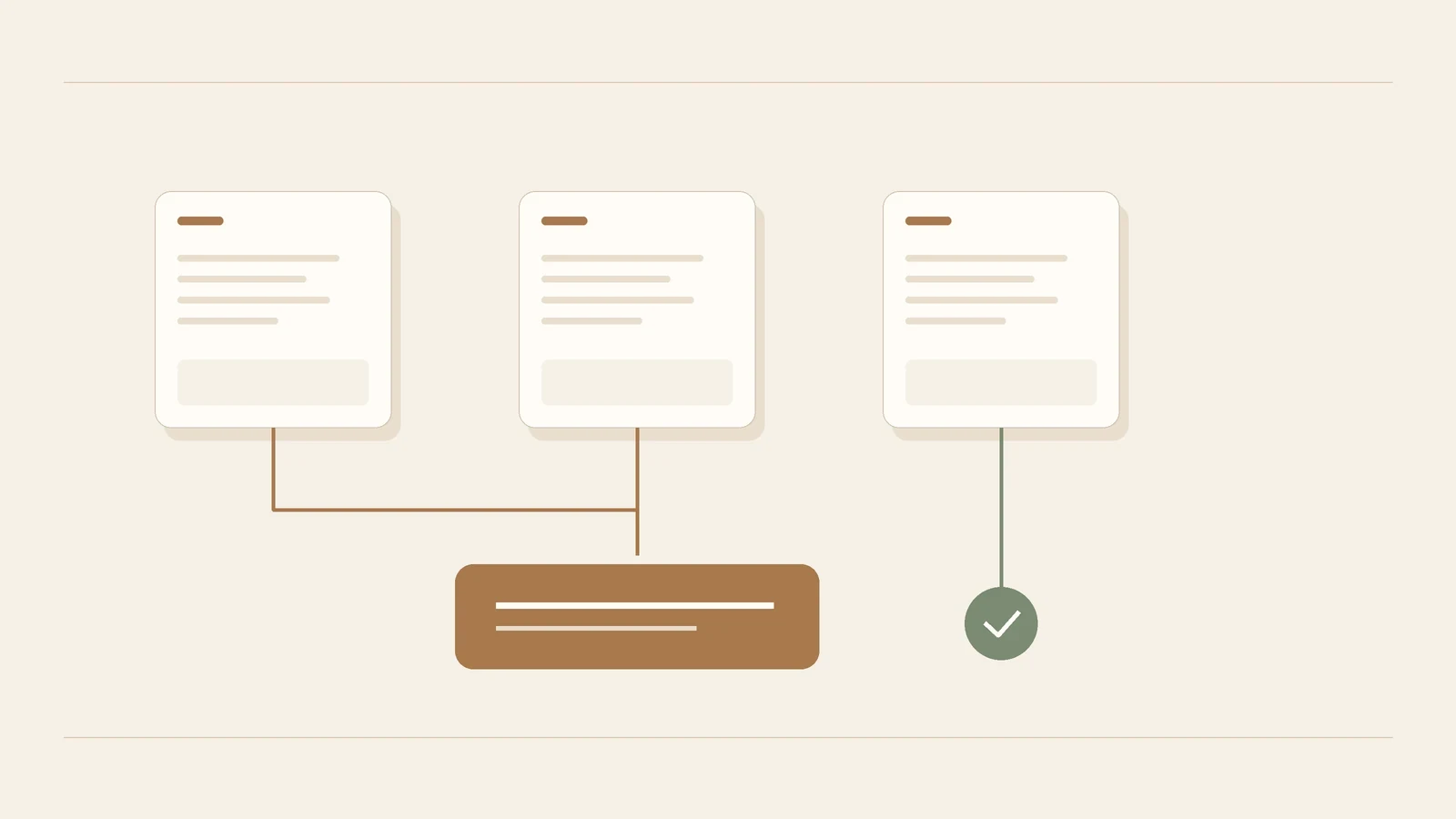
Check suspected overlap before calling it cannibalization
Two pages appearing for a related query can be perfectly reasonable when they meet different needs. A different page appearing on a different day is also insufficient evidence of a problem. “Keyword cannibalization” is most useful as a description of unwanted overlap that deserves investigation, rather than a penalty diagnosis.
Google states that ordinary duplicate content is not itself a spam-policy violation. That is a narrower claim than saying all repetition is harmless. Its canonicalization guidance explains how it handles duplicate pages. Multiple ranking URLs alone do not demonstrate a penalty.
Investigate when interchangeable pages repeatedly attract the same need, the less suitable destination receives relevant visits, or customers encounter conflicting details. Compare the pages, their query patterns, and available business outcomes. Account for country, device, seasonality, and site changes before blaming overlap for a decline.
Choose an editorial fix before a technical setting
Improve the page that already fits
When the existing destination serves the right need but has an incomplete answer, update it. Add missing evidence, clarify its promise, and remove obsolete details. Creating a second article simply to cover a missed subquestion can leave two weaker destinations to maintain.
Make genuinely different pages more distinct
If both pages deserve to exist, clarify their scope in the introduction, headings, evidence, and next step. Keep shared background concise. A guide and a service page may legitimately discuss the same subject while helping readers make different decisions.
Consolidate redundant articles carefully
If the pages perform the same job, choose a suitable surviving destination after reviewing usefulness, existing traffic, links, and business relevance. Preserve valuable material from both. Where a retired page has an appropriate replacement, arrange a permanent redirect and update affected links. Keep a record of old and new URLs so the change can be checked.
Use canonicalization for duplicate versions
A canonical annotation identifies a preferred version of duplicate or very similar content; it does not edit, combine, or redirect the pages. Google treats canonical preference as a signal and may choose differently. Do not point distinct articles to one “main” page merely because they share a keyword. Google's canonical implementation guide explains the available methods and when redirects are appropriate.
Keep the map connected to publishing decisions
Require a map check before approving a new brief. If an assignment already exists, the proposer should explain what the new page adds. Record a consolidation or scope change in the map when it happens, so an old brief does not recreate the page later.
Once page responsibilities are clear, use internal links that follow the reader's journey to connect them. Mapping decides which destination owns the main answer; link planning helps people move between useful destinations.
After a substantial change, note the date and review the affected pages when enough relevant data has accumulated. Check whether visitors reach appropriate answers, whether useful queries remain covered, and whether technical changes work as intended. Avoid promising a ranking increase or judging success from one day's position.
A final check before the next brief
- Have you checked published pages and unfinished drafts?
- Can you describe this page's main reader need in one sentence?
- Does a new URL add a meaningfully different answer?
- Are related keyword variants grouped where they share that answer?
- Are overlap decisions supported by page review and relevant data?
- Does every proposed merge identify what stays and what changes?
- Is someone responsible for keeping the assignment current?
Begin with one important topic area and resolve its unclear assignments before expanding. A useful keyword map makes the next content decision easier: where an answer belongs, what needs improving, and whether another page is worth creating.